
BLOG

How to improve your professional image
Guest blog by professional photographer Thomas Skovsende | Why do so many profile pictures look poor. Check out these tips on how to improve the look of your personal brand, frame and light your image.
By Thomas Skovsende
Do you know one of my pet peeves, as a professional photographer? You’re on LinkedIn and connect with someone new but the picture is really bad – lo-res, from a family barbecue 10 years ago with poor lighting.
I see so many bad shots, I mean, is that how you want to be perceived?! This isn’t as fun and ‘out there’ as Facebook. Be professional; this is your career.
You could say it’s as important as a CV – first impressions count. But then again that is a photographer saying this.
A marvellous thing about smartphones is that you can see yourself when you take a selfie, so there is no excuse.
Lighting your photos wisely

Copyright Thomas Skovsende
Lighting photography is beyond key – the definition of photography is ‘painting with light’.
So don't paint a bad picture with lighting; use lighting wisely. It takes someone seriously talented to get a good picture out of a bare lightbulb, so natural light is your friend.
A window gives a soft side light, and lights your face from the side. But a lamp or lightbulb from the ceiling will give you horrible shadows under your nose, contours on the nose and face.
Find a window, avoid the bright sunlight if there is any. Somewhere bright enough to make you come across positive without being floodlit.

Copyright Thomas Skovsende
Showcase what you do and who you are
If I show up to take your photo I need to know what the focus of the images is; who are you, what do you do, what message do you want to convey, how do you want others to perceive you. These are important points to have sorted out before you even think of clicking that button.

Copyright Thomas Skovsende
Copyright Thomas Skovsende
Regardless if you work for yourself, or are on LinkedIn for networking under a company, you should think about how you are perceived. What is your brand, do I need to match a company brand? That is where you should start, and where photography should start. When you walk up to someone and they say ”What do you do?”, your answer should be succinct and punchy – i.e. “I am a portrait photographer.”
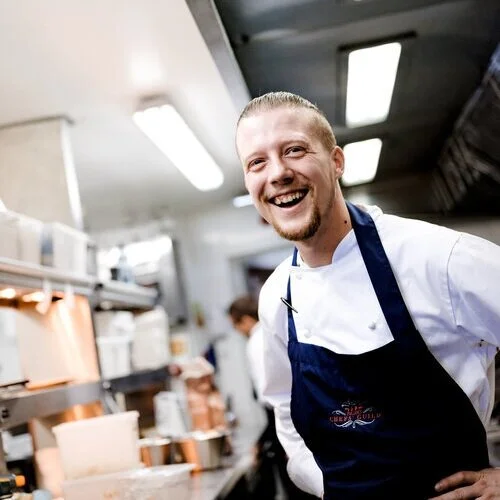
For instance, if you're a chef, you should be in a kitchen, to bring it across. You in chefs whites, and a standout shot with the kitchen in the background and you stirring a pan. Notebooks if you’re a writer. Computer if you work in tech. Helmet if you’re a racing driver. And so on.
It is tricky to bring all of this together in one image, especially when the photos are so small. However, getting a bit of personality, some ‘tools of your trade’ and a relevant background instantly makes you professional. Make it look like your work environment.

Thomas Skovsende
And, of course, if in doubt, please use a professional. Like me :)
Thomas Skovsende is a professional photographer, with more than 35 years’ experience. You can find his portfolio website at www.thomasskovsende.com.

Channel neutral; sector agnostic
How to be strategically objective – brand projects and marketing/PR campaigns require a fresh look to remain unbiased by legacy decisions and activity. At Authentic, we take a channel neutral, sector agnostic approach.
As taglines go, it is less snappy than Wieden + Kennedy’s ‘Just Do It’ for Nike, or KFC’s currently-controversial “Finger Lickin’ Good”.
However, as Authentic presses on into month eight, the phrase ‘channel neutral; sector agnostic’ has evolved to become a mantra for client work and project discussions.
So, what does it mean, and why is this wannabe slogan important?
Channel neutral
Whether looking at a project brief, branding evolution, or talking a campaign proposal through with a prospective client, starting with a clean sheet in terms of channel is the strategic route. This ensures there is no bias around a particular approach, or preferential treatment given to channels that may have worked in the past.
The crucial aspect about being neutral is to not give one [channel] preference over another without resetting and looking at the specific objectives, messages and audiences.
A channel, in this sense, could be arranged by:
Format – written, audio, ATL/BTL (good explainer here), video, infographic;
Activity – rebrand, social media, advertising, email, new digital magazine, influencers, content marketing, blog writing, partnerships, face-to-face events [irony intended]; or
Platform – owned media (blog or website), Google PPC, LinkedIn organic, Facebook ads, Daily Mail, Radio 4 or a B2B title.
Equally, it can be divided in myriad ways, depending on your viewpoint. The crucial aspect about being neutral is to not give one preference over another without resetting and looking at the specific objectives, messages and audiences.
Sector agnostic*
In communications, the generalist vs specialist debate has been rolling on for decades.
Competency across a number of different sectors can be outweighed by in-depth knowledge of one specialist industry. Equally, you could be seen as having an experience that is too broad, or being siloed – pigeonholed in one area.
The phrase ‘sector agnostic’ moves the conversation on – it means you have no bias or preference to any area of work, regardless of whether or not you’ve worked in it before.
Each project is taken on face value, and worked through in the same manner – looking at the data and making insight-led decisions, based on the behaviours of your intended target audience(s).
Avoiding bias
By being ‘non-partisan’, and not simply focusing on that channel which previously worked in answering a similar challenge – be that from Authentic’s POV or the client’s – means we’re tackling each challenge objectively.
Removing bias from the equation, where possible – be that conscious or unconscious from the client, from consultant, from stakeholders, from the audience even – means that each piece of activity is given the best chance of success by being fairly measured and evaluated.
In terms of communications measurement, we’ve thankfully moved on as a sector since AVE’s. Outputs, outcomes and potential impact should be the balanced focus of measurement and evaluation for any activity. See more on the AMEC Barcelona Principles 3.0 here.
Fresh eyes; new viewpoint
Furthermore, coming to a challenge or opportunity with no baggage, legacy decisions or ideas of what ‘will or won’t work’, adds an element of freshness that can sometimes be missed by those focused on one sector.
Final point, who doesn’t like a semi-colon?!
If you want to speak about an upcoming project or a business challenge you have, get in touch by email, calling +44 7870408102, or check out this short video on how Authentic works.
*Credit where it’s due, this part of the adopted Authentic slogan came from a conversation with strategic in-house comms pro Rebecca Zeitlin (a UK-based American colleague, originally from Kentucky – check out her straight-talking here).

How personality of place helps the public sector produce great communications
Kate Vogelsang: Effective local gov comms – for local authorities, personality of place is a key tool to effectively communicate public services with their communities. They know local history, what makes their area tick and how to tell stories that are authentic to the area and evoke a sense of pride.
Brand and your communications strategy; one of the key areas we professional communicators need a very good understanding of, whoever we work for.
We’re not quite at the point where we can stop explaining to people that your brand is NOT your logo, but I think (hope) we’ve come quite far. And have a look at this discussion on the relative merits (or otherwise) of council logos and you’ll see how little importance is placed on logos in the public sector. The views that people have of their public services are more deep-seated than design elements; it’s much more personal than that.
Place-based branding
For the public sector, and particularly local authorities across England, place-based branding - or, to put it another way, personality of place - is really important. Places, just like each of us as people, often have unique characteristics that give them identifiable personalities.
So knowing and understanding your audience so you can communicate effectively is also about knowing and understanding where they live, at both a macro and micro level, and what it means to them.
It’s why so many councils and local health care services pushed for a localised message for Covid-19 communications. What works for London won’t always work for rural communities in Lincolnshire, tourist hot-spots in Cornwall, or cities like Bradford or Birmingham.
Effective communications for communities
There are other reasons to get this right. An effective place branding can help promote an area as a visitor destination, persuade people to move there, or bring funding into local areas. Economic development is high up the list. The government set up the Towns Fund in November 2019 which will invest £3.6billion into over 100 towns and towns have been bidding for this funding by putting together bespoke proposed investment plans. Preston are one town bidding for funds.
Personality of place can manifest itself in many ways and local public services are well placed to produce effective communications for their communities. They know the local history, what makes their area tick and how to tell stories that are not only authentic to the area, but that evoke a sense of pride.
Not every organisation gets it right, of course, but here are five examples of where the public sector have pitched their communications just right for where they are:
Liverpool council and the football fans cleaning up the city - core to the personality of the city of Liverpool is football. It’s a unifier: or a divider, given there are two big teams, Everton and Liverpool. They’re proud of their footballing history. So when Liverpool won the league after a 30-year wait, this was a big thing. This is a lovely video made by the council about the clean-up operation after the celebrations, and how fans joined forces with the council to keep their city clean.

Midlands road-signs translation - personality of place is also about celebrating the differences. And possibly the most noticeable difference between areas in the UK is in accents and language. I haven’t a clue what this road sign says, but for those living in Dudley I’m sure it made perfect sense.
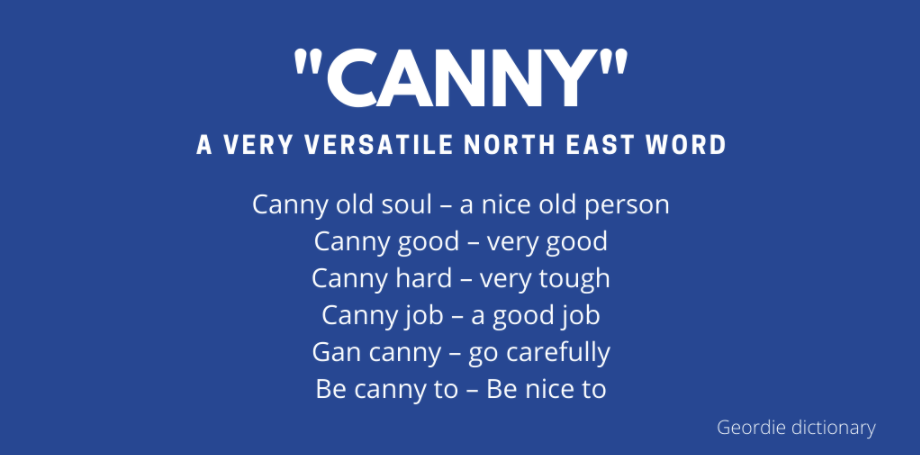
North Tyneside Council’s Covid comms - another example of language, this time for Covid, and the use of the word ‘canny’. They also did something similar with a weather warning for Storm Ciara (which seems so, so long ago!)

Communicating health messages to a Jewish community in London - sometimes diversity in an area brings additional challenges. Communicating with the 30,000 people in the Jewish community about Covid involved many different approaches, including using trusted voices to get the message across. This video does it really well.

Manchester transport - more humour in signage, this time using song lyrics and football puns, and a bit of Manchester City and Manchester United taunting. Again, football is integral to the city and the signs are instantly relatable to so many people who live there.
Kate Vogelsang is the founding director of Birdsong Consultancy, and specialises in public sector communications, in particular local government and health.
If you’ve got an idea for a blog, or are interested in writing a piece for Authentic, get in touch with Adam here.
Campaign: Aha! Now, that's what I call podcast PR
Alan Partridge’s new Audible podcast 'From the Oasthouse' | Using video, radio ads & Linkedin’s organic social media algorithm to promote via fans, advocates and people connecting with ‘The Real Alan Partridge’.
The promotion of Alan Partridge’s new podcast has been ramping up for months and, just when you think it had run out of gears, this happens...

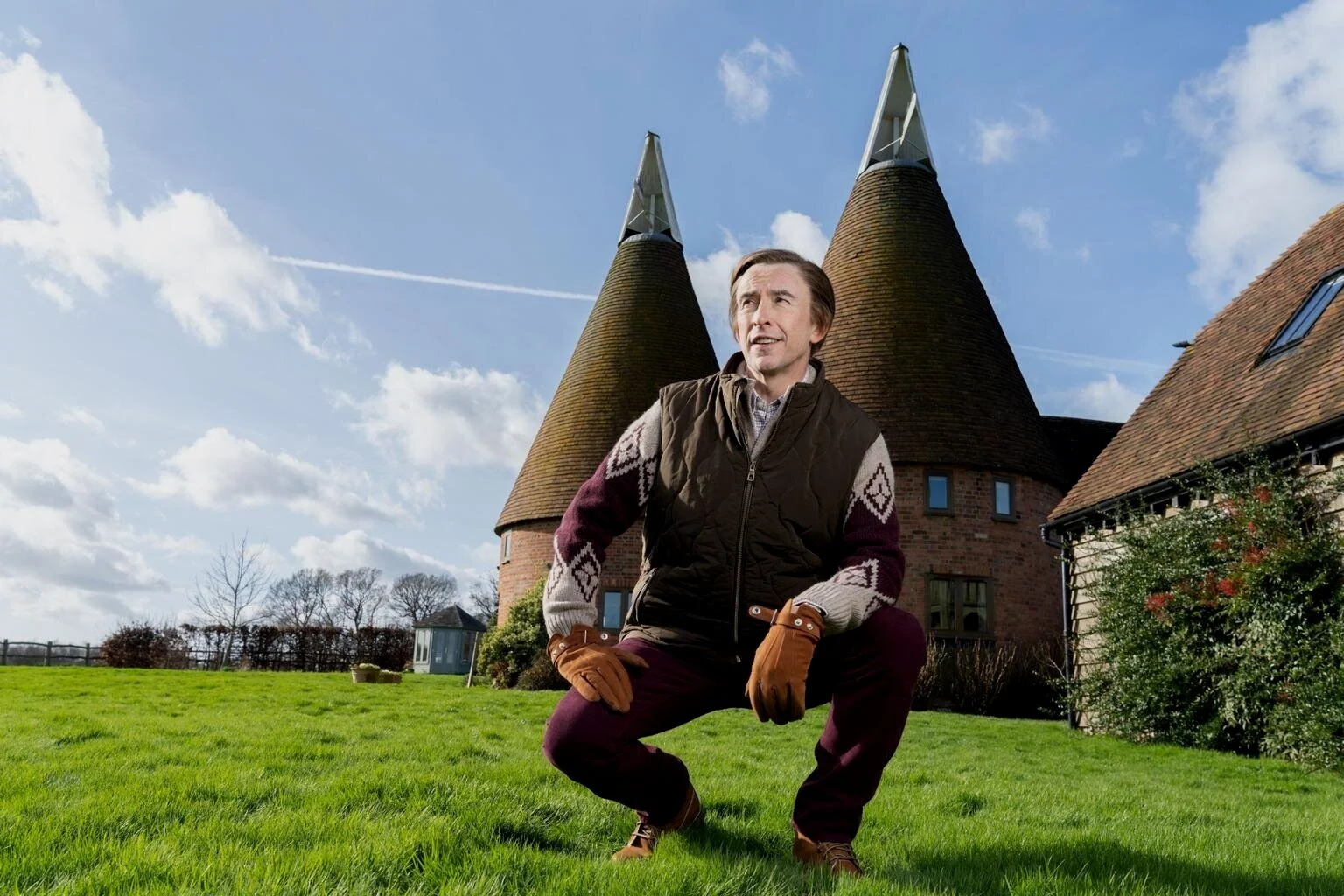
The 11ft Alan Partridge statue outside Norwich train station to promote his new podcast on Audible (Courtesy of BBC News)
Radio adverts, video clips and outtakes, a clever, well-run LinkedIn account (yes, I have followed), and now an 11-ft statue in his hometown of Norwich.
Whoever is behind the campaign – I’ve checked with a few sources and nothing confirmed yet – deserves a hearty round of driving-glove-wearing applause, followed by a few pints of real ale (no ‘Ladyboys’, thank-you-very-much).
So, after being off our screens for just over a year (since The One Show parody ‘This Time…’ in 2019), exactly how has Alan bounced back… this time…
The podcast: From the oasthouse
The 18-part podcast series was revealed earlier this year and since then radio (“the thick globules of my voice dripping into your ear folds…(sic)”) and TV adverts, alongside organic social media activity, have formed the basis of the campaign.
Podcasts have been continually gaining popularity in recent years (Spring 2020 RAJAR data below, shared by Podnet), and impressively maintaining this popularity during lockdown, even though commuting was vastly reduced. See the recent RAJAR lockdown figures here.

Amazon-ing campaign?
Alan’s From the Oasthouse podcast is an ‘Audible Original’ (everyone else noticing a lot of Orignal’s nowadays? Might be reaching peak Original soon) so has the might of Amazon, and depth of pockets, to make this a success.
Flexing its product diversity muscles, Amazon’s marketing machine has the power of Audible and Alexa at its fingertips. However, the irreverent humour behind the campaign’s organically-shared assets could be the key to cut-through, not the advertising spend. Although, that helps!
Video trailers
Very Partridge, just what we need right now?
Who is the real Alan Partridge? Join Alan in a new series of podcasts from his Oasthouse, only on Audible.
#AlanPartridge #Audible We love Alexa but...she's no match for Lynn.
Organic LinkedIn creativity
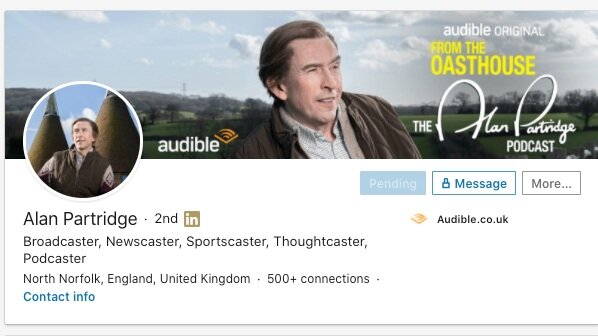
Yes, I have Connected…
In addition to the video trailers, audio adverts across radio stations (still a decent platform with good reach, folks) and the spread of print/digital coverage and angles – Irish Times ‘To this day there’s never been a story published suggesting Alan Partridge has tits’, NME’s ‘Nine unmissable moments’ and DigitalSpy exploring why it’s ‘…about more than making people laugh’ – the team behind the Audible promotion have chosen to use LinkedIn.
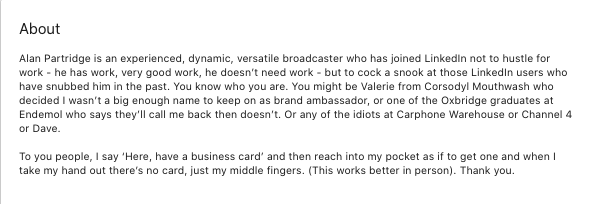
Launching an Alan profile earlier this month with an article entitled ‘Think Yourself Creative': a thought piece’, the uniqueness of LinkedIn is that it focuses on organic interaction and engagement ON the platform.
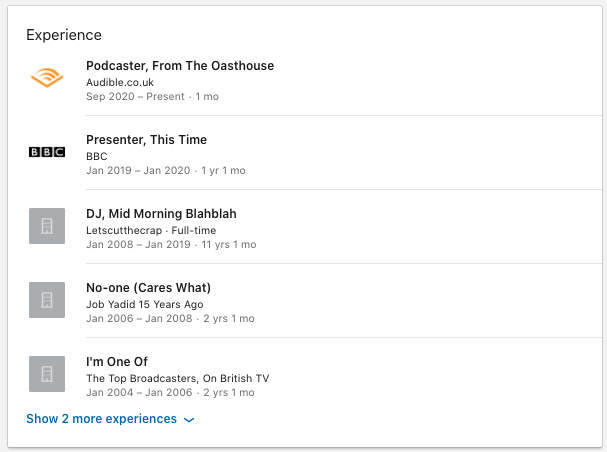
By enabling fans and interested people to like, comment and follow The Real Alan Partridge, it means that they don’t have to spend money on ads. The advocacy of people clamouring to ‘Connect’ with Alan – a character created by Steve Coogan, in case you’ve been living on another planet since the 90s – means that engagement and subsequent visibility of his profile, content and promotion of the podcast is pushed out by LinkedIn’s algorithm.
Very clever.
Your thoughts?
Is Alan the tonic we need right now? What do you think of the campaign? Even if not a fan of the character, what are your views on its execution/timing of a podcast and balance of traditional channels and LinkedIn’s organic algorithm?
Is this as much of a coup for Alexa and Amazon as it it for Mr Coogan…?
Am I too much of a Partridge fan boy?! (yes)
Let me know below; don’t be reserved – interested in your thoughts.
Four free project management tools to check out
Whether you’re managing an in-house team at a not-for-profit, local gov or sector specific area, an agency working across multiple clients, disciplines and spinning plates, or a freelancer collaborating with others, these tools can be the extra organisational kick you may need.
‘Teamwork makes the comms dream work’
Me, August 2020
Every organisation, business, or brand works in a different way, yet at times there are comparable pinch points. Common themes we can all relate to.
Someone not copying a person into an email, a deadline missed, miscommunication and uncertain expectations. We’ve all been there.
As well as the somewhat-annoying Monday.com (adverts EVERYWHERE), there are plenty of free-to-use tools and programmes out there to help with cross-team/department communication and ongoing project management.
Efficiency & Productivity
Whether you’re managing an in-house team at a not-for-profit, local gov or sector specific area, an agency working across multiple clients, disciplines and spinning plates, or a freelancer collaborating with others, these tools can be the extra organisational kick you may need.
I’ll leave Microsoft Teams (the annoying “we live on Teams” advert – ironically with Monday.com ad on YouTube) and Zoom to one side. We’re all well-versed.
The programmes below are but a few of the options to help you and your teams manage, coordinate and focus efforts, helping to increase productivity and efficiency. And, they’ll hopefully help you look really good.
Four free tools to enhance communication
1. Trello

Trello: a ‘productivity power-up’
Ah, Trello. A trusty steed. My go-to project management tool, that (I’ve recently learnt) can link up with email and your calendar for smooth, no-stress reminders and flags.
A ‘productivity power-up’, Trello helps to sync information across teams, ensuring visibility and delegation/responsibility of tasks with a simple, drag-and-drop interface and reminders. Nice interface, and developers love it.
Link: https://trello.com/en
2. Google Suite
Gmail, Google Drive, Keep, Docs, Sheets, Meet, Hangouts, Slides… it is almost endless. Wouldn’t be a technology list without adding in the don of the them all (whose parent company is worth more than US$1tn. One trillion dollars…*cue Dr Evil*).
‘Work faster, work smarter’ – all about personal preference with this suite of tools and programmes – if you love collaborating in real time, on shared docs in Drive, this one’s for you. Great free alternatives to Word and Excel, but get used to links being shared/invites to collaborate, not attachments.

Google Suite: more apps and tools than you can shake a stick at
3. Slack

Slack: ‘where work happens’, apparently
It’s apparently ‘where work happens’. The concept here is to chat more regularly, missing out tragic email threads with dozens cc’d. Channels are where the quick conversations take place, the brainstorms, the quick questions.
Slack also integrates with 2,200+ apps – from Salesforce, to Zoom, to Outlook. Have used this with a number of clients and it works well to keep in contact on a more regular basis, without feeling like you’re waiting for answers.
Link: https://slack.com/intl/en-gb/
4. Float
Float is more for scheduling a team’s (or your teams’) workload, capacity and availability. A resource planning tool that enables you to see, at a glance, who has space for projects, and what can be moved around.
Good if you have a number of designers, writers, content-creators account managers or other colleagues to manage.
Link: https://www.float.com/

Float on: a resource planning tool for managing teams’ capacity
Let me know what you think – do you use any of these? Do you use other products? Do you care?!
Write a comment below, share this link with a colleague or get in touch with me.

Mind the values gap
Guest blog from Jackie Le Fevre (Magma Effect) | “Unsurprisingly, there’s lots of chatter saying core values are vital to organisational survival. Some commentators reckon values are more important than ever….. I don’t entirely agree.”
“It’s in an emergency that an organisation’s true values become clear.” | Mark Rowland for the Chartered Management Institute in April.
“Covid-19 means there is more focus on people and human rights now, and we are seeing the companies that continue to look after their people – be it in their operations or supply chains – will lead the global recovery from an employee engagement and brand perspective.” | Paulina Murphy of World Benchmarking Alliance in June.
Unsurprisingly, there’s lots of chatter saying core values are vital to organisational survival. Some commentators reckon values are more important than ever….. I don’t entirely agree.
Every organisation has a range of values which matter most collectively to the people of that place. This has always been so. Those values are the energies that drive problem solving, creativity, kindness and fuel determination in ways that no rule book or handbook ever could.
There is danger ahead: not from a lack of values per se, but from discernible gaps between declared core values and the ones lived out in everyday interactions.
Kareline Daguer of PwC says it well: “This crisis will test firms’ ability to live up to their stated ambitions and core values. Now, more than ever, winning or losing may depend on whether you were able to do the right thing at the right time for both your employees and your customers.”
What that ‘right’ thing looks and sounds like depends on the values your organisation says it holds as core and what it actually holds as core. When an organisation demonstrably makes decisions and takes actions which honour the stated values (and even better explains how the values have been operationalised in that process) then we experience that company/charity/business as authentic.
Be in no doubt, as the world turns to life post pandemic, to be experienced as authentic will be powerful and comms folk may find themselves expected to work their magic in that pursuit.
Associate Professor Juan-Carlos Molleda, in his 2010 review of authenticity in PR and Communications, says “authenticity claims must capture the experiences, aspirations and expectations of the involved segment of society that organisations aim to engage; otherwise, a clash of values and beliefs may occur and the strategic public relations and communication management efforts may be lost”.
As we get ready to #buildbackbetter, or whatever rallying call is being used where you are, what can be done on the values and authenticity front?
Three Suggestions:

Look hard and listen carefully to spot and capture stories from the past few months which embody the most meaningful values lived by your people
Check alignment thoughtfully: don’t just tick the stories off against the “values” printed on posters and coasters; peel back the layers of the stories for the energy that lay behind both what was done and how it was done and see if it truly all lines up.
Gap or No Gap? If you don’t find a gap between ‘talk’ and ‘walk’ that’s great – now amplify what you have found. If there is a gap then you have an opportunity. This is a chance to course correct your organisation to move beyond dated, or overly generic, statements of values to something fresh which better conveys the unique spirit of your enterprise and which you can show has already been making a kind of difference that counts
Everyone everywhere has had a very personal experience of the pandemic.
For some, it has reinforced that things they cared about truly do matter very much and they have a renewed sense of focus. For others it has shown that some (many) things they cared about do not matter even half as much as other things they had been taking for granted, for them the coming months will be ones of reappraisal and possibly reorientation.
I suspect the same will prove true for organisations – where do you think yours sits just now?
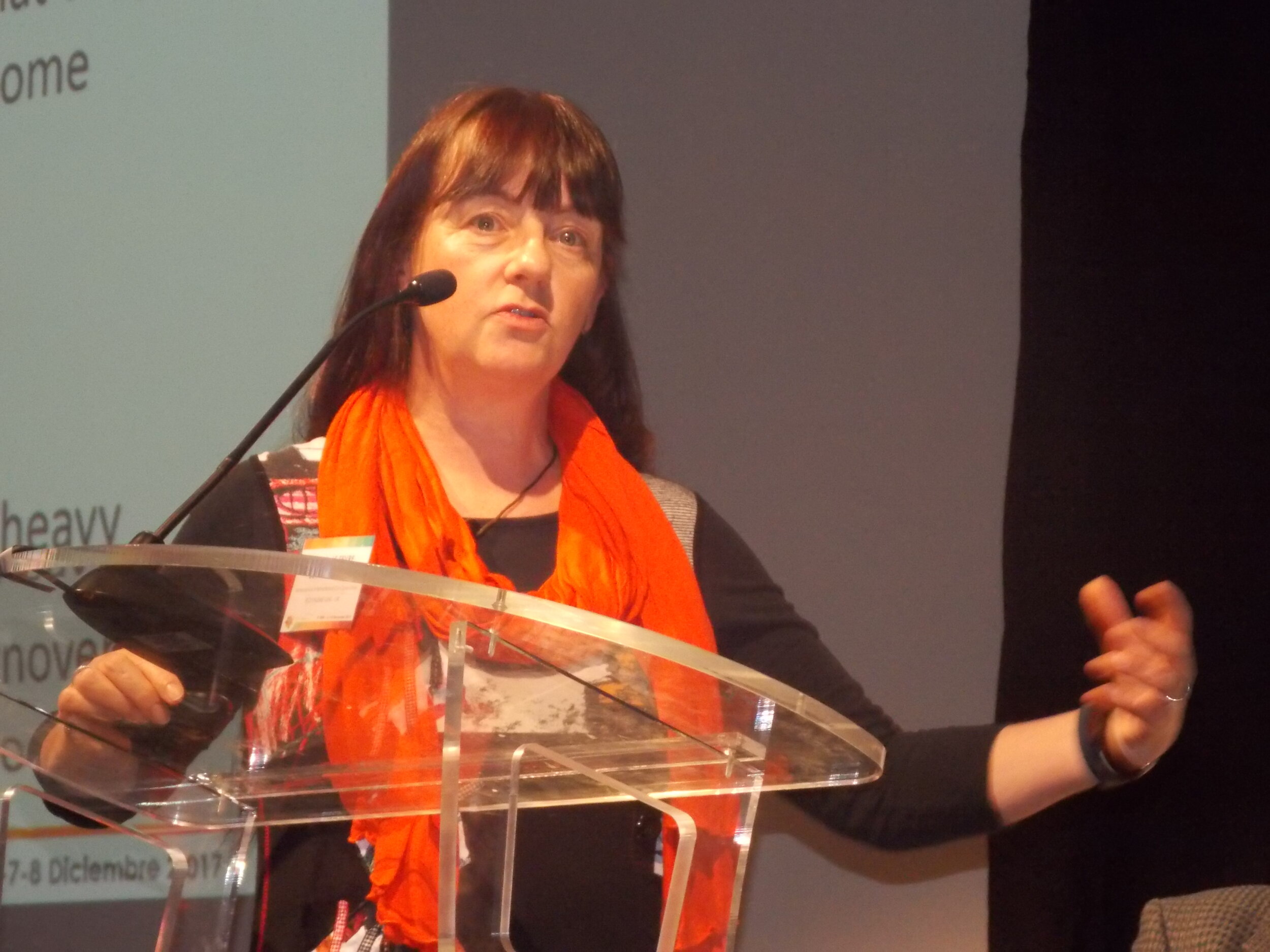
Jackie Le Fevre of Magma Effect
Let us know in the comments below, or contact me directly at jackie@magmaeffect.com.
Jackie Le Fevre is the UK lead for Minessence Values Framework, putting theory to practice with Magma Effect, and is currently embarked upon a PhD exploring values.
Campaign: Carlsberg UK's Mean Tweets (2019)
“Carlsberg tastes like the rancid p*ss of Satan.“ Not the best thing to promote on Twitter..? This award-winning PR campaign from Carlsberg UK was a disruptive, strategic PR project. It led on spinning the negative – sometimes offensive – tweets about the brand, in a multi-stage, engaging content marketing campaign comprising paid social, intrigue and video.
“Carlsberg tastes like the rancid p*ss of Satan.“
The above may not seem to be the best thing for the Carlsberg UK team to be promoting on Twitter, yet this ‘Mean Tweets’ campaign from 16over90 rightly won the PR category at the The Drum Marketing Awards Europe 2020.
A disruptive, strategic project, it led on spinning the negative – sometimes offensive – tweets about the brand, in a multi-stage, engaging content marketing campaign, comprising paid social, intrigue and video.
The background
Carlsberg had lost its way. The proud Danish brewer (UK brewing in Northampton) had become one of the pack – nothing standout about it in terms of quality, or point of difference. It was no longer ‘Probably the best beer in the world’ – a great piece of copywriting, in my opinion. [Check out the background to that brilliant slogan here.]
So, the Carlsberg marketing team partnered with 16over90, who were supported by Fold7 and Initiative to deliver the creative.
Subtly-promoted tweets
Firstly, they took negative tweets from past years and subtly promoted them across Twitter. This got picked up by a number of trade mags including The Drum – ‘Why is Carlsberg promoting tweets branding its beer the 'rancid piss of Satan'?’

Collated negative tweets promoted by CarlsbergUK (c/o The Drum)
What next?
After stirring up curiosity and online discussions, creating awareness, the next step was to bring the tweets to life.
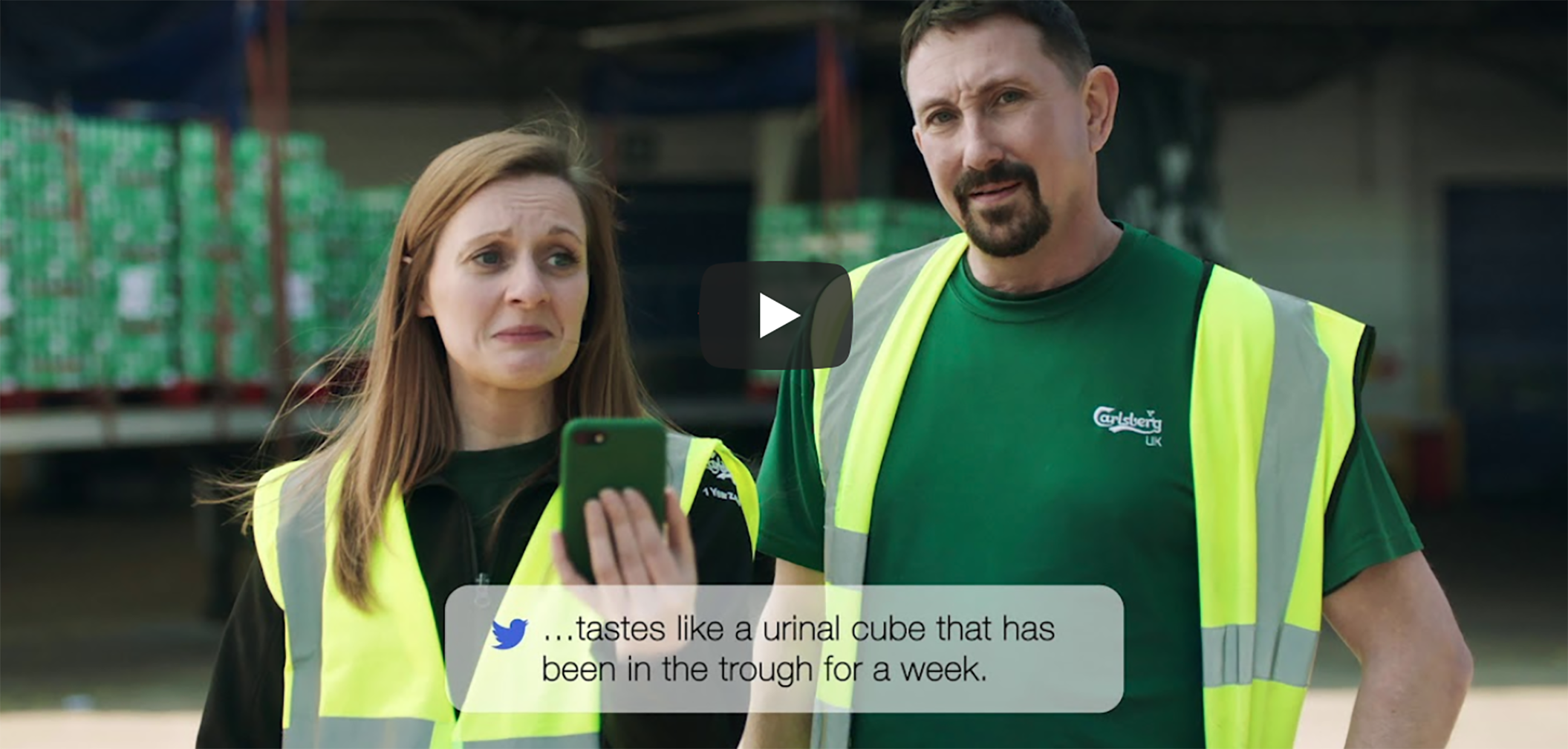
Taking a range of real Carlsberg UK colleagues from across the company – including senior directors, finance and marketing, delivery drivers, brewers, call centre teams and more – these employees were filmed speaking directly to the camera, reading out the tweets and giving their opinions. It appears that they have genuinely not read them before by their apparent honest reactions (see below)!
This was then followed up with a second video of more employees from across the business reading out relatively offensive and – at best – not positive tweets about their eponymous product. The product that pays their wages, the brand that is above the door as they come to work. Very funny, and bringing the people who are Carlsberg to the fore. Taking the conversation out of the Twitter echo chamber worked well.

This was followed up with out of home (OOH) advertising, driving discussion about Carlsberg not being the best beer. These clever 48-sheets (see right) and digital advertising screens at key areas around the country helped develop the conversation with the overarching strategy for Carlsberg’s new positioning.

There are (almost) no new ideas
Quick one on creative ideas. There are very rarely completely new ones.
The skill comes from taking insight, innovative ideas and things that previously have worked, and tweaking them to reach your specific objectives.
Others have undertaken similar approaches, with KFC promoting negative tweets to relaunch their ‘crap’ fries in 2018, and American chat show host Jimmy Kimmel has got celebrities to read out mean tweets about themselves since at least as 2016.
However, what the Carlsberg UK ‘Mean Tweets’ campaign did was bring together different elements to meet the objective of the client – to create awareness through controversial online discussion curiosity, to create conversation, backed up with human, authentic (!) video responses from real colleagues, and drive intrigue ahead of a massive new brand marketing relaunch around quality.
In my opinion, this is a brilliant adaptation/extension of the negative tweet formula to emphasise a strategic move from the company to acknowledge that in the past their beer was not the best quality.
What do you think?
Clever or basic? Let me know below. Read more about the campaign from The Drum here.
Get in touch if you have any other ideas of campaigns that have impressed or surprised you and I'll take a look. Or if you would like to write something for my blog, maybe looking at a campaign that impressed you, please let me know.
See other campaigns I’ve covered here:

What next? Tradeoffs. Lots of tradeoffs
After coronavirus | In his second blog for Authentic, Tom Johnson takes a look at the future impact of the COVID crisis on the economy, and what the economic fallout could be. In short, tradeoffs.
It’s been a decent few weeks for the hospitality sector in the UK. After months of lockdown, shutdown and restart planning, pubs, bars, restaurants and cafes finally reopened at the start of July.
It hasn’t looked quite the same – table service, online bookings, cashless payments and sign-in sheets weren’t commonplace in every venue pre-pandemic – but after a cautious start, consumers are coming back. Scenes like those in Soho on July 4th have been rare, while Eat Out to Help Out and the continuation of good summer weather – except in those places where England are attempting to play cricket – are resulting in some renewed optimism for the sector and the economy.

But despite the restart, the pandemic isn’t over.
As the government’s chief scientific adviser was keen to impress on us in April, we are in this for a very long time. In July, Chris Whitty redoubled this message, emphasising that the move towards reopening the economy was at the limits of what was possible while Professor Graham Medley (Chairman of SAGE) warned last weekend that pubs may need to shut again in order to allow schools to reopen in September.
The reconfiguration of daily life
Put simply, the government have a range of levers to pull to reopen society. Pull all of them – i.e. lift all measures – and the virus can spread unchecked. At the moment, the lever marked ‘hospitality and leisure’ has been pulled forward. In a few weeks it may need to be pushed back in order to enable the lever marked ‘schools’ to come forward.
Since Medley’s comments, the government have played down the prospect of hospitality shutting again – but reported cases have stopped declining. Whatever precise action the government takes in order to safely reopen schools in September the message is clear: until a vaccine comes along – and possibly after – the future is in tradeoffs such as the one between schools and pubs.
These are present everywhere, creating a group sectors or businesses losing out as a result of the disruption and a group that spy opportunities in the reconfiguration of daily life.
Some examples:

Airbnb and the UK’s prominent tourist destinations seeing rises in domestic leisure tourism, while airports, airlines and firms reliant on foreign holidays (e.g. Hays Travel) struggling
The railways being essentially renationalised while cycling reaches 400% of normal volumes (source: DFT)
High street retail struggling (Laura Ashley, Cath Kidston, John Lewis) while courier giant Hermes plans to create 10,000 new jobs
Footfall in city centres failing to support retail and hospitality demand while satellite and commuter towns see their midweek populations swell as a result of home workers
What next in this crisis?

In some ways, disruption, tradeoffs and winners and losers are a feature of any crisis, including recessions. But this crisis has three unique features:
The immediate, universal impact of this crisis. Recessions take time to hit, and hit some sectors or groups of consumer months before others. With Covid-19, virtually the entire country shut down at the same time; behaviour was forced to change virtually overnight
Different priorities at different times. This is a rolling, and possibly seasonal crisis. After months of shutdown, the government are taking new steps to help stimulate consumer demand, especially in the leisure sector over the summer. Come the autumn, education will again be the priority.
A fragmented, divided country. Even pre-pandemic, we were in the midst of a febrile and divisive culture war. There will be winners and losers from the pandemic: as a sense of national unity and togetherness fades, this will deepen pre-existing divides.
The exact shape of future societal, political and economic trends over the next few months is uncertain. But one thing is clear: this is a zero-sum game. For one rule to be relaxed, another restriction must be implemented.

Tom Johnson is Managing Director of Trajectory, a leading trends and foresight consultancy. Tom and Trajectory use data and forecasting techniques to understand changing consumer behaviour and map out the future.
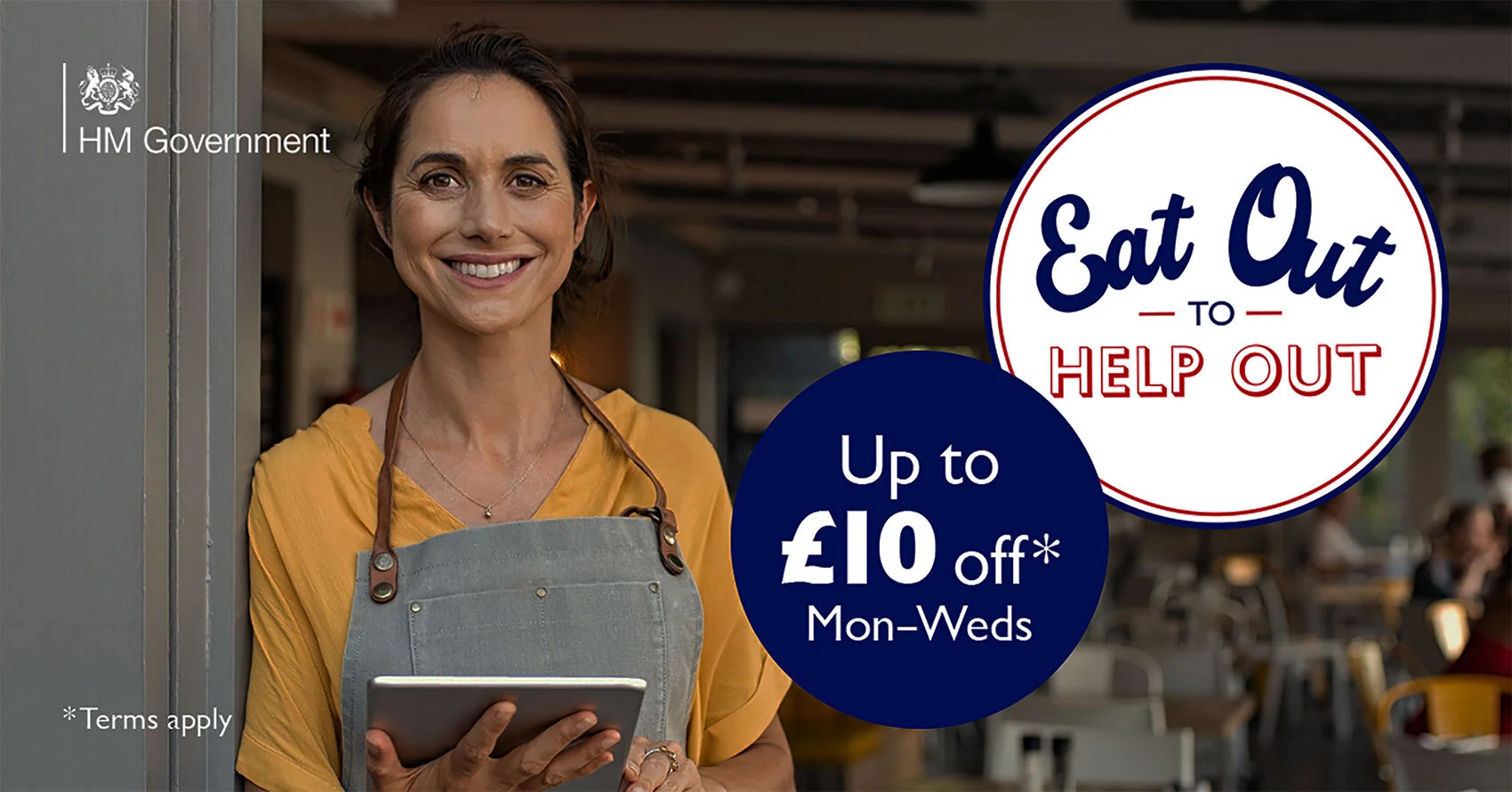
Why #EatOutToHelpOut is bigger than hospitality
Hospitality is more than the Eat Out to Help Out campaign | The sector employs 2.9 million people, generates £130bn in economic activity and pays £38bn in taxes. The latest scheme from Rishi’s Treasury – the #EatOutToHelpOut campaign – is hoping to stoke the fires of the economy through driving people to hospitality venues, like pubs, restaurants and cafes, across the UK.
As the BBC, Sky News and Big Hospitality – among others, I’m pleased to see – explained yesterday, the latest scheme to try and boost the economy and save thousands of jobs has kicked off.
What is the Government’s #EatOutToHelpOut scheme?
For those unaware, Rishi’s #EatOutToHelpOut campaign is hoping to stoke the fires of the economy through driving people to venues across the UK.
As Propel said yesterday, “anyone visiting a participating restaurant, cafe or pub on Mondays, Tuesdays and Wednesdays in August is eligible to receive a half price discount, which will be paid for by the government. The discount, aimed to “keep more money in hardworking families’ pockets”, applies to all food and non-alcoholic drinks, with a maximum limit of £10 per person.”
Putting aside the jokes around the hashtag*, and the government’s recent chequered history of communicating messages, this is a campaign I am throwing my increased lockdown weight behind.
Why hospitality?
What does hospitality mean to you – good service? Friendliness? Being made to feel at home?
For me, hospitality means a hardworking industry of frontline and backroom colleagues, people you do and don’t see, working hard to provide great experiences, time and time again. That can be from the most delicious, high-end meal for a special anniversary, the weekend away with mates at a hotel, B&B or Airbnb, to the takeaway coffee, lunch from the sandwich shop, or dinner and drinks at the local.

It means licensees and franchisees, tech SAAS whizzes, ops managers, bar and waiting staff, cleaners, porters, chefs – executive, sous, commis and all in-between – accountants, marketing, PR and event departments, pot-washers (did my four years!), the maitre’d or host, welcoming visitor teams, leisure venues, and a tonne of important roles I can’t fully list here.


In addition, there is an army of supportive industry roles that are crucial to the hospitality ecosystem – supply chains from local food and drink producers to the wider foodservice world from the big boys (Brakes, 3663 etc.); farmers and agriculture, be it dairy, crop, vegetable, fruit, livestock or fish; breweries, cideries, wine, soft drink, coffee and tea producers; importers and exporters of everything you could imagine; catering businesses; photographers and videographers. The list goes on.
UKHospitality is one of the leading voices representing the broad hospitality sector, which it describes as:
“…a major contributor to the UK economy, employing 2.9 million people and generating £130bn in economic activity, while paying £38bn in taxation to fund important local and national services.”
Hospitality is the 3rd largest private sector employer in the UK; double the size of financial services and bigger than automotive, pharmaceuticals and aerospace combined.” – UKHospitality
Furthermore, Gov.uk says that 8% of the UK’s workforce – more than 2.4 million people – rely on hospitality, accommodation and attractions for employment. Within this, food and beverage services and venues (cafes, pubs, restaurants etc) account for 1.8 million jobs.
Confidence as much as income
As well as giving such an important industry a much-needed injection of cash and footfall on traditionally quieter days, the hope is that consumer confidence will be boosted too, and this will hopefully last far longer than August.
As Fuller’s boss Simon Emeny (full disclosure, my former boss too) said in the recent pub company’s FY results:
“…it is encouraging to see customers returning to our pubs and this steady growth in consumer confidence will be the key to success – not just of our Company or our industry, but the economy as a whole.”
I strongly believe that giving people an element of reassurance about their safety, the cleanliness, the social distancing and answering ‘how will this work’ is as – if not more – important as the initial bottom line.
What can I do to get involved?
I’m a hospitality venue:
More than 72,000 businesses have signed up. Register here. You can use the scheme to offer a discount to diners and encourage them to eat at your restaurant:
all day, every Monday, Tuesday and Wednesday from 3 to 31 August 2020
to offer a 50% discount on food or non-alcoholic drinks to eat or drink in (up to a maximum of £10 discount per diner)
to claim the money back from the government
I want to support hospitality venues near me:
NO VOUCHERS NEEDED. Just rock up and eat.
Check out venues near you here. Or call up and ask, or check their social media, or see a poster in a window.
So, please, please, please get involved with this scheme – it is a great opportunity to support a fantastic industry and bolster the economy.
Do it safely, make sure you respect other people and wash your face, cover your hands and keep alert about your lunch. Or something like that.
Seriously, though, be kind and be respectful of everyone.
✌️

*A good friend of mine pointed out that swapping the word ‘Eat’ for ‘Dine’ would have saved a lot of hassle…

Four 'non-brand' Twitter accounts full of personality
Personality and tone of voice is key to lots of brands, but there are great examples of public services, local government and the arts Twitter accounts punching above their weight. #Localgov and small social media teams have been doing great work – here are just four brilliant accounts to follow.
Think of Twitter tone of voice, or accounts with funny, engaging personalities, and you probably think of Innocent, Greggs and Paddy Power, right?
Whatever you feel about the brands or products, they certainly have a specific tone of voice that resonates with their audiences and underlines their personalities. [See here for more on another favourite of mine, Oatly]
In this post, I wanted to highlight the great work done by social media teams that may not get as much visibility as those above, but are as much – if not more – creative, effective and engaging.
These examples are brands in their own right but aren’t as widely-known, and definitely have smaller teams and marketing budgets as the big boys. These accounts are from the public service, local gov, emergency services, and creative & arts worlds – worlds under constant financial pressure.
The social media manager, content team, creative director, graphic designer and customer service hats are usually worn by one or two people. Their line managers have given them creative reign and empowered them to grow the social following as they see fit. And the results speak for themselves (see here and here).
Give them a follow and see what you think. All links are in the headlines, as well as pasted below. And if you have other accounts I should be following, or that should be highlighted, please let me know. Happy to do a mk2 of this, if there are other emergency services, hospital trusts or such accounts doing a sterling job.
The Museum of English Rural Life (@theMERL)
Comin’ straight outta Reading, this account has captured imagination with funny and creative posts and threads exploring “the English countryside, its history and its people.”
Based at the University of Reading, the Museum of English Rural Life social team are hilarious, filling boring monotonous timelines with fresh thinking and irreverent takes on old pictures from our rural past.
Take, for instance, this image. Some cows in a field. Add some creative licence and witty copy, and you have increased your engagement and boosted your reach.
The account is now hitting 153k followers; not bad for a museum!
Doncaster Council (@mydoncaster)
In terms of local gov or council accounts, Doncaster lead the way, in my opinion. Slaying it, in fact. (thanks to Darren Caveney of Comms2Point0 introduced me to this breath of fresh council air a few years back, and boy what a treat)
Turning ‘at-first-glance’ stuffy one-way traffic into engaging, thought-provoking content on a regular basis takes some doing. From this 2018 PRWeek review, the local authority smashed records for engagement in 2017-18, with 71,000 likes in total, and one tweet using the #DoncasterGrittingWorldCup hashtag received 10k+ likes and 5k+ retweets! Even got into The Guardian.
As with all social, the great ideas and associated innovative content created has to come from somewhere, so props to the wider team behind Doncaster Council for their continued positive efforts into conversing directly and enjoyably with their audience. Changing perceptions of what a council can be. Give both @RobJefferson and @liam_social a follow, too 👏 !
The second campaign I wanted to showcase was about flytipping (see below). In itself, a dry topic at best. Not with the creative minds from @MyDoncaster behind it. Again from the 2017 heydays, the speedboat thread includes cleverly-layered GIFs in a storytelling vein to keep people scrolling. A masterpiece of how social can be truly engaging on a topic which, at first look, could be considered dull.
I was only made aware of this recently, but they’ve done some sterling work over the lockdown period – keeping me entertained, at least.
Again using threads – something to note for new social managers, perhaps – they’ve ignited conversation across the platform, especially with the currently-pinned genius thread on Dame Judi Dench as objects in the museum’s collection.
Other recent posts include two-way interaction between followers with a poll on upcoming content, as well as sharing other facts and information from their family of museums – did you know a family of puffins is called a circus?
Great, creative work from a team under real financial pressure in recent times – thinking outside the box and repurposing what they already have.
South Yorkshire Fire & Rescue (@SYFR)
Not forgetting the incredible work comms teams behind a variety of emergency services do across social media, check out South Yorkshire Fire & Rescue. (Thanks to Mandy Pearse for the heads up on this one)
The award-winning Twitter account covers the South Yorkshire hubs of Barnsley, Doncaster, Rotherham, Sheffield, as well as surrounding areas.
For many years, the SYFR account has focused on communicating confidently and directly with its audience, winning a Comms2Point0 award for its engagement team in 2016 among others.
Campaigns highlighted included an electrical safety promotion, a firefighter fitness push and, more recently, two focusing on batteries in fire alarms and cooking after the pub:
The account is a great conduit for sharing fire and Yorkshire partner posts, and corporate communication manager Alex Mills has recently blogged about the impact SYFR’s 2019 work has had on the community it serves. Read it here.
That’s a mere snapshot of the great work done by social teams across the UK. If you have other local gov/public services accounts that are deserving of an honourable mention, get in touch!